
For years, trans fats were everywhere-from packaged cookies and pastries to shortening, margarine, and restaurant frying oils.
Food manufacturers liked them because they could improve texture, increase shelf life, and help certain products stay solid at room temperature.
The problem is that your heart does not share that enthusiasm.
Understanding trans fats and heart health matters because these fats have an especially unfavorable effect on blood cholesterol. They can raise LDL, often called “bad” cholesterol, while lowering HDL, commonly known as “good” cholesterol.
That combination can encourage plaque buildup in the arteries and increase cardiovascular risk. Many countries have taken major steps to remove industrial trans fats from their food supplies, but they have not disappeared everywhere.
WHO continues to recommend keeping total trans fat intake below 1% of daily energy intake and avoiding industrially produced trans fats whenever possible.
So, what exactly are trans fats, and why have health authorities worked so hard to reduce them?
What Are Trans Fats?
Trans fats, also called trans-fatty acids, are a type of unsaturated fat with a particular chemical structure.
Some trans fats occur naturally in small amounts in foods from ruminant animals, including cows, sheep, and goats. That means small quantities can be found in certain meat and dairy products.
The bigger historical concern has been industrially produced trans fat.
Manufacturers traditionally created these fats through a process called partial hydrogenation. Hydrogen was added to liquid vegetable oil, changing its physical properties and making it more solid and stable.
The resulting partially hydrogenated oils, often called PHOs, became popular ingredients in processed foods because they could improve shelf life and texture.
However, their advantages for food manufacturing came with serious cardiovascular disadvantages.
Why Are Trans Fats Bad for Your Heart?
The main reason trans fats are considered particularly unhealthy is their effect on cholesterol.
Eating trans fats can increase LDL cholesterol while reducing HDL cholesterol. LDL contributes to cholesterol accumulation in artery walls, while HDL helps transport excess cholesterol away from the bloodstream.
That means trans fats can push your cholesterol profile in the wrong direction from two sides.
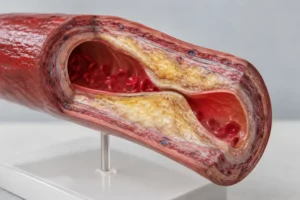
Over time, unhealthy blood lipid levels can contribute to atherosclerosis-the buildup of plaque inside arteries. As plaque develops, blood vessels may become narrower and less flexible.
If arteries supplying the heart become affected, the risk of coronary heart disease rises. Plaques can also rupture and trigger blood clots, potentially causing a heart attack or stroke.
WHO reports that high trans-fat intake is associated with increased coronary heart disease and mortality and estimates that more than 278,000 deaths each year can be attributed to industrially produced trans fat consumption.
That is a lot of cardiovascular harm from an ingredient your body does not actually need.
How Much Trans Fat Is Too Much?
When it comes to trans fat, less is better.
WHO recommends that adults keep trans-fat intake below 1% of total daily energy intake. For someone eating approximately 2,000 calories per day, that works out to less than about 2.2 grams per day.
That does not mean 2.2 grams is a daily target you should try to reach.
It is an upper limit.
Industrial trans fats have no known health benefit, so there is no nutritional reason to deliberately include them in your diet. WHO specifically recommends replacing them with healthier sources of unsaturated fat.
This is different from nutrients such as protein, fiber, or essential fatty acids, where your body actually needs a certain amount.
With trans fats, the practical recomendation is simply to keep exposure as low as reasonably possible.
Where Are Trans Fats Found Today?
Trans fats have become much less common in some countries because of regulations and food reformulation.
In the United States, the FDA determined in 2015 that partially hydrogenated oils were no longer “generally recognized as safe.” Manufacturers were subsequently required to remove PHOs from most food uses, dramatically reducing the major source of artificial trans fat in the U.S. food supply.
Globally, however, the situation varies.
Industrially produced trans fats may still appear in certain margarines, vegetable shortenings, commercially baked products, packaged snacks, fried foods, and restaurant or street foods, particularly where strong elimination policies have not yet been implemented.
WHO research in Indonesia, for example, tested 130 products and found that almost 10% of the sampled foods exceeded recommended trans-fat limits. Higher levels appeared in products including biscuits, wafers, bakery foods, margarine mixtures, and some street foods.
This is why geography matters.
A food that has been reformulated in one country may still contain industrial trans fats somewhere else.
How to Spot Trans Fat on a Food Label
Checking the Nutrition Facts panel is a good starting point, but the ingredient list can be equally important.
Look for terms such as “partially hydrogenated oil.” Historically, this has been one of the clearest signs that industrial trans fat is present.
There is also a small labeling detail worth knowing.
Under U.S. FDA labeling rules, a food containing less than 0.5 gram of trans fat per serving may legally display 0 g trans fat on the Nutrition Facts panel.
For most modern U.S. foods this is less important than it once was because PHOs have largely been removed, but it shows why serving size and ingredient lists still matter.
If a product contains tiny amounts and you eat several servings, those amounts may add up.
When shopping internationally, label rules can vary, so learning to recognize hydrogenated oils can still be useful.
Also pay attention to the serving size. A nutrtion label describes nutrients per listed serving, not necessarily the entire package. Eating two servings means consuming roughly twice the listed amount of most nutrients.
Are Natural Trans Fats Safer?
Trans fats occur naturally in small quantities in the meat and dairy products of ruminant animals.
You may therefore wonder whether natural trans fat is completely different from industrial trans fat.
WHO currently recommends limiting trans fats from all sources and states that both naturally occurring and industrial trans fats can negatively affect health.
However, people generally consume natural trans fats in smaller quantities than the amounts that were historically possible when partially hydrogenated oils were widely used in highly procesed foods.
That distinction is important.
You do not necessarily need to become anxious about trace amounts of trans fat in a balanced meal. The bigger goal is reducing overall exposure while choosing a dietary pattern rich in foods that support cardiovascular health.
What Should You Eat Instead?
Removing unhealthy fats is only half the equation. What replaces them also matters.
The American Heart Association recommends replacing foods high in saturated and trans fats with sources of monounsaturated and polyunsaturated fats.
Good options include olive oil, canola oil, nuts, seeds, avocado, fatty fish, soy foods, and other foods rich in unsaturated fats.
These fats can help lower LDL cholesterol when they replace less healthy fats in the diet.
For example, instead of regularly cooking with shortening or solid fats, you might use an appropriate liquid vegetable oil. Instead of relying heavily on packaged pastries for snacks, you could choose nuts, fruit, yogurt, or another minimally processed option.
The point is not to eliminate dietary fat.
Fat is an essential nutrient that provides energy, supports cell function, and helps your body absorb certain vitamins. The goal is to improve the quality of the fats you eat.
Does Avoiding Trans Fat Guarantee a Healthy Heart?
Unfortunately, heart health is not determined by one nutrient.
Avoiding industrial trans fats is useful, but someone could eat almost no trans fat while still having other major cardiovascular risk factors such as high LDL cholesterol, smoking, hypertension, diabetes, physical inactivity, or a strong family history.
Your overall dietary pattern also matters.
A heart-supportive diet generally includes vegetables, fruits, whole grains, legumes, nuts, seeds, healthier oils, and appropriate protein sources while limiting heavily processed foods high in unhealthy fats, sodium, and added sugars.
Physical activity, adequate sleep, tobacco avoidance, blood pressure management, and regular cholesterol testing are also important parts of cardiovascular prevention.
So, do not treat “0 g trans fat” as a magical health label.
A cookie that contains no trans fat is still a cookie. Its total nutritional value depends on everything else inside it.
Small Food Choices Can Add Up
You do not need to obsessively calculate every gram of fat you eat.
A more practical approach is to create habits that naturally reduce trans-fat exposure.
Cook more meals using unsaturated oils, check ingredient lists on packaged foods, limit frequent consumption of deep-fried and commercially baked foods, and choose minimally processed foods more often.
If you eat at restaurants regularly, you can also pay attention to cooking methods. Grilled, steamed, roasted, or baked dishes may sometimes be better choices than heavily fried options, depending on how they are prepared.
And remeber that cardiovascular health is about patterns rather than isolated meals.
Eating one pastry will not suddenly cause heart disease. What matters much more is what your diet looks like across months and years.
The relationship between trans fats and heart health is clear enough that health organizations around the world have worked to remove industrial trans fats from the food supply.
These fats can raise LDL cholesterol, lower HDL cholesterol, promote atherosclerosis, and increase the risk of coronary heart disease. Fortunately, exposure has declined substantially in countries where partially hydrogenated oils have been restricted or eliminated.
Still, checking food labels and choosing healthier fats remains worthwhile, especially when eating packaged, fried, bakery, or imported foods.
Focus on unsaturated fats from foods such as nuts, seeds, fish, avocado, and plant oils while keeping industrial trans fats as low as possible.
Your next step does not need to be complicated: check the ingredient labels on a few foods you regularly buy and see what kind of fats you are actually eating.