
Imagine eating well, exercising regularly, and still receiving an LDL cholesterol result that is surprisingly high. For some people, the main reason is not a lack of healthy habits. It is an inherited condition called familial hypercholesterolemia.
So, what is familial hypercholesterolemia? Often shortened to FH, it is a genetic disorder that makes it harder for the body to remove low-density lipoprotein, or LDL, from the bloodstream.
People with FH are born with elevated LDL, so their arteries may be exposed to excess cholesterol for many years. FH matters because high LDL usually causes no early symptoms.
Someone can look and feel healthy while cholesterol gradually contributes to plaque inside the arteries. Without early diagnosis and treatment, FH increases the risk of coronary artery disease and heart attack at a younger age.
Fortunately, cholesterol testing, family history, and sometimes genetic testing can identify the condition. Effective treatment can significantly reduce LDL and protect long-term heart health.
How Familial Hypercholesterolemia Affects LDL
LDL particles carry cholesterol through the bloodstream to cells that need it. The liver normally removes excess LDL using structures called LDL receptors.
In familial hypercholesterolemia, an inherited genetic change disrupts this recycling process. The liver cannot clear LDL efficiently, allowing more cholesterol-carrying particles to remain in circulation.
FH most commonly involves changes in the LDLR gene, which provides instructions for producing LDL receptors. Changes in the APOB and PCSK9 genes can also cause the condition, while rarer forms may involve genes such as LDLRAP1.
Having some LDL is normal and necessary. The problem is the unusually high level and the length of exposure. Because FH begins at birth, the lifetime cholesterol burden can be much greater than in someone whose LDL rises later because of age or lifestyle.
How Common Is Familial Hypercholesterolemia?
FH is more common than many people assume. The CDC estimates that it affects approximately 1 in 311 people, while other medical sources commonly place the figure around 1 in 250 to 300.
Despite this, many affected people remain undiagnosed. High cholesterol is usually silent, and families may not notice a pattern until someone develops heart disease or experiences a heart attack at an unusually young age.
For example, imagine a healthy 32-year-old with an LDL result above 200 mg/dL whose father had a heart attack at 46. That combination does not automatically confirm FH, but it should lead to a detailed medical and family-history assessment.
Very high LDL in children or young adults is especially important because lifestyle-related cholesterol problems are less likely to explain such severe elevations at an early age.
What Are the Main Types of FH?
There are two main forms of familial hypercholesterolemia. Their severity depends partly on how the disease-causing genetic changes are inherited.
1. Heterozygous Familial Hypercholesterolemia
Heterozygous FH, or HeFH, is the more common form. A person typically inherits one altered gene copy from one affected parent.
Most common forms follow an autosomal dominant inheritance pattern. This means each biological child of an affected parent generally has a 50% chance of inheriting the genetic variant.
2. Homozygous Familial Hypercholesterolemia
Homozygous FH, or HoFH, is much rarer and more serious. It occurs when a person inherits harmful changes affecting the LDL-removal pathway from both parents.
Children with HoFH can have extremely high LDL and may develop cardiovascular disease very early in life. They usually require specialist care and more intensive treatment than people with HeFH.
Does Familial Hypercholesterolemia Cause Symptoms?
Most people with FH have no obvious symptoms simply from having high LDL. This makes a cholesterol blood test essential for identifying the condition before complications develop.
When cholesterol levels remain extremely high, visible deposits may occasionally appear. Tendon xanthomas are firm cholesterol deposits that often affect the Achilles tendon or tendons in the hands and fingers.
Yellowish deposits around the eyelids, known as xanthelasmas, can also occur. Some people may develop a pale or gray ring around the cornea. However, these signs are not present in everyone, and their absence does not rule out FH.
Symptoms such as chest pressure, calf pain while walking, or stroke-like changes usually indicate that artery disease may already have developed. Sudden chest pain, facial drooping, difficulty speaking, or weakness on one side requires emergency medical care.
Why Does FH Increase Heart Disease Risk?
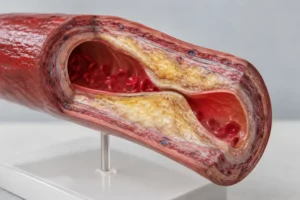
High LDL gives more cholesterol-containing particles the opportunity to enter and become trapped inside artery walls. Over time, cholesterol, immune cells, calcium, and other materials may form atherosclerotic plaque.
Plaque can narrow an artery and reduce blood flow. It can also rupture suddenly, causing a blood clot to develop. A blockage in a coronary artery can cause a heart attack, while one affecting the brain may cause an ischemic stroke.
The main concern with FH is cumulative exposure. Someone born with high LDL may experience decades of artery stress before a person with later-onset high cholesterol reaches a similar level.
This explains why early detection is so valuable. Reducing LDL during childhood or early adulthood can limit the total amount of time the arteries spend exposed to damaging cholesterol levels.
How Is Familial Hypercholesterolemia Diagnosed?
Diagnosis usually begins with a lipid panel, which measures LDL, HDL, total cholesterol, and triglycerides. An untreated LDL level of 190 mg/dL or higher in an adult is an important warning sign, although it is not enough to diagnose FH by itself.
A healthcare professional will also ask about close relatives with very high cholesterol, coronary artery disease, or heart attacks at young ages. Physical signs and personal medical history may provide additional clues.
Other causes of high cholesterol may need to be ruled out. Thyroid disease, kidney problems, liver conditions, diabetes, and certain medications can also affect cholesterol levels.
Genetic testing can confirm a disease-causing variant in many cases and may help guide family screening. However, a negative result does not always exclude FH because current tests may not detect every possible genetic cause.
Why Family Screening Is Important
When one person is diagnosed, their parents, siblings, and children may also be affected. Testing close relatives one group at a time is called cascade screening.
This approach can identify people before high LDL causes noticeable artery disease. Because common forms of FH often give each child of an affected parent a 50% chance of inheriting the condition, one diagnosis may reveal several additional cases in the same family.
Screening can involve a lipid panel, genetic testing when a family variant is known, or both. Current guidance supports evaluating children early when close relatives have FH, severe high cholesterol, or premature cardiovascular disease.
Finding FH during childhood does not mean a child is already ill. It gives the family and medical team an opportunity to reduce lifelong cholesterol exposure before serious complications develop.
How Is Familial Hypercholesterolemia Treated?
Treatment focuses on lowering LDL as early as possible and keeping it controlled. Heart-healthy habits remain important, but diet and exercise alone are usually not enough because the underlying problem is genetic.
Statins are commonly the first medications prescribed. They reduce cholesterol production in the liver and help the liver remove more LDL from the bloodstream.
When statins do not lower LDL sufficiently, additional medicines may be considered. These can include ezetimibe, PCSK9-targeting therapies, bempedoic acid, or other treatments chosen according to the person’s age, risk, and medical history.
People with severe FH may need several medicines together. Some individuals with HoFH may require specialized treatments or lipoprotein apheresis, a procedure that filters LDL from the blood.
Healthy habits still provide valuable protection. Eating more vegetables, fruit, beans, whole grains, nuts, fish, and unsaturated fats supports cardiovascular health. Regular activity, avoiding tobacco, and managing blood pressure or diabetes also reduce additional heart risks.
Familial hypercholesterolemia is an inherited condition that causes very high LDL cholesterol from birth. Because the body cannot remove LDL efficiently, cholesterol exposure builds over time and can lead to premature artery disease, heart attack, or stroke.
FH often produces no early symptoms, making family history and cholesterol testing especially important. Very high LDL, early heart disease in close relatives, or a known family diagnosis should prompt professional evaluation.
Review your latest lipid results and ask relatives about their heart-health history. If FH is suspected, speak with a qualified healthcare professional about testing, treatment, genetic counseling, and cascade screening.
Finding the condition early may protect not only your health but also the health of your children, siblings, and other relatives.